How Public Data Reveals Which Companies Will Grow

29.7.2026

7 min
reading time

29.7.2026
7 min
reading time
BizMachine co-founder Martin Ondas was a guest on the Ekonom weekly podcast "Na vlně podnikání". He explained why the richness of a company's digital footprint says a lot about its growth potential - and why looking only at revenue in the financial statements is not enough.
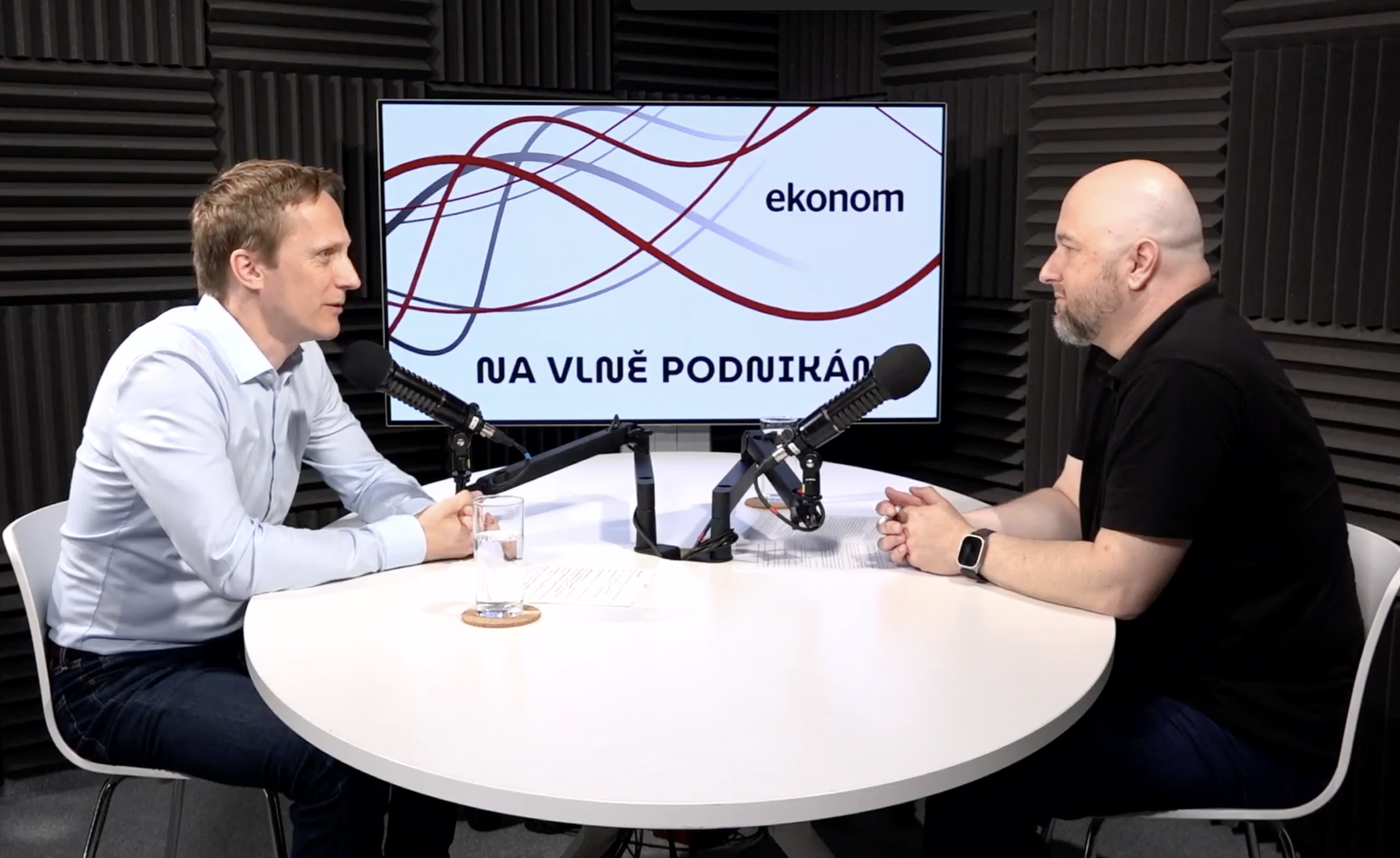
Most salespeople and managers look at companies statically: what their revenue is, where they are based, what industry they operate in. But according to Martin Ondas, a strong growth signal is something else. The richer the digital footprint a company leaves behind, the more professionalised it is on the inside - it has processes in place and communicates clearly to the outside. And a professionalised company is one that has the potential to grow, invest, and buy.
That is the logic BizMachine builds on when it works with data on more than 11.7 million companies across five Central European markets. We summarise the main points of the conversation, including quotes. You can listen to the full episode on the Ekonom podcast.
Note: the quotes from the podcast have been edited for readability. The episode was recorded in Czech and Slovak; the quotes here are translated into English, and their meaning is preserved.
Over the past two years, working with data has changed. What used to take painstaking programming can now largely be handled by AI. Basic information retrieval is no longer a competitive advantage.
"What still had to be programmed two years ago is now largely generated by AI. What has not changed is that the value lies in interpreting the data, and less in collecting it."
Martin Ondas, co-founder of BizMachine, takes a sober view of AI. It is not a magic wand, he says - it only amplifies what you put into it. If you do not know what you want to find, AI will not help you at all.
"AI is just a kind of multiplier or amplifier of your intent. You have to know what that intent is for it to be able to help you."
According to Ondas, one thing is most often overlooked: how people look at data. A static view tells you what a company is today. A dynamic view tells you where it is heading.
"Most people look at data statically. We look at it dynamically too: what has changed over the last three months."
A dynamic signal is a new technology, a growing marketing team, an investment in new premises, or a won public tender. There is a lot of this data and it is hard to collect and analyse, which is why, according to Ondas, most companies do not work with it. BizMachine tracks these buying signals continuously and compares them across sources.
The digital footprint is at the heart of the whole conversation. For small and mid-sized companies, where the numbers are large enough to be statistically meaningful, one thing clearly holds: the richer the digital footprint, the greater the growth potential.
"The richness of the digital footprint is a huge predictor of how professionalised the company is. And how professionalised the company is, is a big predictor of whether it has the potential to grow."
What specifically makes up the digital footprint:
Ondas singled out job ads as an especially strong source.
"Job ads are a great source. In them, companies often say something about their strategy, about where they are going to grow."
One ad is not enough. A signal emerges only from enough data, when the same thing shows up across multiple sources.
"Our specialty is working with low-quality or incomplete data. You cannot rely on just one source. Only when you see a piece of information in multiple sources is it a signal you can work with."
Data matters, but business is done by people. The data will not make the decision for you - it only prepares the groundwork for it.
"Data will not make the decision for you. It can prepare the groundwork, it can help you with it, but in the end the person makes the decision in the given situation."
That is where intuition comes in. Ondas has nothing against it, he just does not like the word. It often serves as an excuse.
"Many times when people say they are intuitive, it is more a kind of laziness. Laziness to pull up the data, get to know it, find out what it says. The word intuition often means: I am not going to look at the data. I saw it, I heard it, someone told me."
Some people do not read the data out of laziness, others simply do not trust it. Mostly, though, it is because they have not yet learned to work with it.
Ondas's approach is scientific: a hypothesis comes out of the data and needs to be tested quickly in practice. What looks great from behind a desk can fail in the field - the data was imperfect, or you hit a flaw in the process. The reverse is also true. Sometimes the data shows something that then works fantastically. Until you try it, you will not know.
Ondas described a specific case that his colleague handled. She helped a client set up a filter in Prospector, and conversion to prospects rose from roughly 20 to 67 percent.
Higher conversion also means less frustration. Dozens or even hundreds of pointless meetings simply disappear. But according to Ondas, it pays off even more to get to know the customers a company already has. An account manager with 100 to 200 companies in their portfolio simply cannot remember everything.
In 2022, CzechCrunch ran an article with the headline that BizMachine collects data "on goats, e-shops, and Teslas". The host returned to it in the podcast, and Ondas confirmed that it still holds today. Agricultural subsidies reveal who keeps goats. Vehicle fleets reveal a shift to electromobility.
"We see, for example, that a company has 30 vehicles in its fleet and has just bought its first electric car. That can be an interesting signal that it is starting some kind of change."
More interesting is that such a signal can predict demand in a completely different sector. Buying a Tesla may not relate only to energy. It can mean the company is open to new services in telecommunications or banking too. When data is connected this way, conversion goes up and the number of pointless sales calls goes down.
The conversation also has a more personal thread. Martin started out as a software engineer. Then he spent years in the USA in the aerospace and defence industry, where NASA was one of the clients. The way back to Europe led through McKinsey. There he met two other Martins, and together they founded BizMachine.
There was also a comparison of the Czech and American approach to data. And a look at what taught him the most in business: focusing on one thing. Interested in learning more? Listen to the Ekonom podcast.
Want to see the digital footprint of your target companies? Try Prospector for free.


Tereza Rejchrtova
Tereza Rejchrtova helps people understand how to use data to their advantage. She has over five years of experience in SaaS marketing, specializing in product and content marketing for B2B. She focuses on connecting complex topics with clear, accessible content.


Pernerova 697/35
186 00 Praha 8
Czech Republic

+420 735 121 860
