How to Lead a Sales Team Using a Competency Map

19.6.2026

5 min
reading time

19.6.2026
5 min
reading time
How can you tell if your sales team is truly hitting the mark? Most sales leaders believe they have a clear view. However, because every manager’s criteria and every rep’s perception differ, these conflicting views often spark misunderstandings. In a recent BizMachine webinar, Jaroslav Salva—a sales mentor with 20 years of leadership experience—shared a tool that fixes this: the competency map.
Every experienced sales director has an idea of how their best salesperson should operate. What they say to a customer at first contact, how they prepare for a meeting, or how they respond when a customer hesitates.
The problem is that this idea exists only in their head and nowhere else. Every manager has a slightly different version, and every salesperson interprets it in their own way.
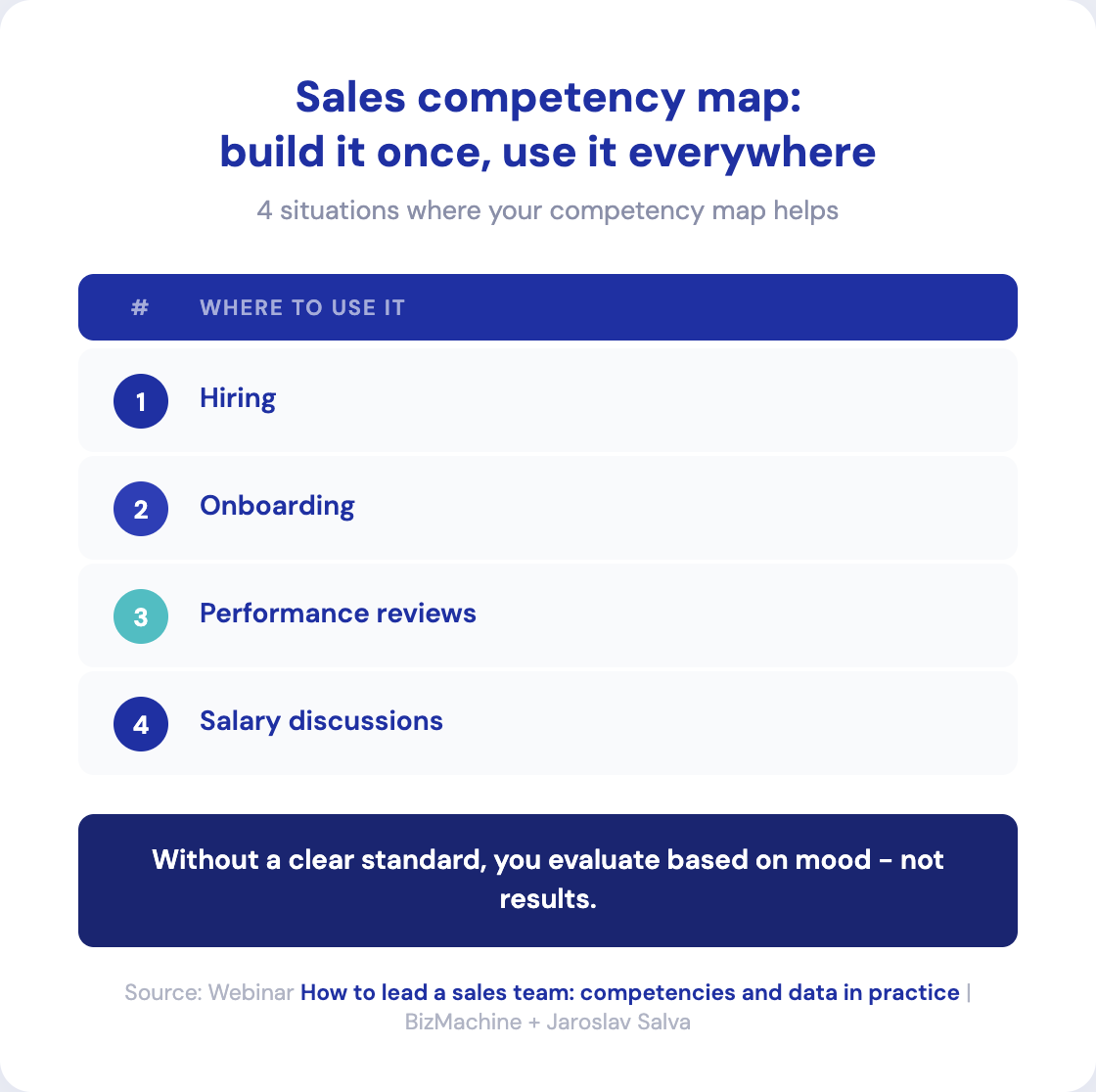
A competency map makes this idea precise and puts it in writing. Once you have it on paper, you can use it everywhere you currently rely on gut feeling: hiring, onboarding, performance evaluation, and salary discussions.
A competency map is a document that describes how a salesperson should work - not what they do, but how they do it. Once you have it, it serves as a reference point for hiring, onboarding, performance reviews, and salary discussions. The competency map is not an HR document. It is a tool for the sales director.
A job description describes what a salesperson does. A competency map describes how they do it.
A job description responsibility like 'building customer relationships' tells neither the sales rep nor their manager anything about how the task should actually be executed. A competency map practically demonstrates what relationship building looks like during an initial meeting, a follow-up call, or during contract negotiations. In doing so, it sets crystal-clear expectations for the salesperson.
A competency map consists of three areas: knowledge, skills, and values. Knowledge describes what a salesperson must know. Skills describe how a salesperson should behave at each stage of the sales process. Values and attitudes show what qualities are expected of a salesperson and what they mean in practice.
There are three types of knowledge a salesperson needs: knowledge of the product or solution, knowledge of the customer, and knowledge of the market or competition.
Customer knowledge is the most difficult of the three areas. "Learning the product, learning the sales craft - that is not so hard," noted Jaroslav Salva. "But customer knowledge - how the company works, how decisions are made there, what your software does to them - that is the most difficult of all competencies."
This is why a competency map does not just say "must have it" for customer knowledge - it describes what it looks like in practice. What the salesperson knows about the customer's company, how they understand their decision-making, and how they use this before a meeting. This is the foundation for development and for hiring.
Skills correspond to the stages of the sales process and describe how a salesperson behaves at each stage: finding and approaching potential customers, discovering needs and building relationships, preparing and defending a proposal, negotiating, working with existing customers.
This is where a senior differs most from a junior. In approaching new customers, a senior independently identifies companies worth approaching based on product strategy. A junior works according to clearly defined criteria that you prepare for them.
Responsibility, reliability, willingness to overcome obstacles, desire to succeed. This part of the map tends to be the most complex - not because these qualities are hard to name, but because everyone imagines something slightly different by them. "What does it mean when a salesperson is reliable?" asked Jaroslav Salva at the webinar. This is exactly why it is not enough to just list values. You need to describe how they specifically manifest in the work of a salesperson at your company.
A competency map has four direct applications: hiring, onboarding, performance evaluation, and salary discussions.
In hiring, you will encounter the first challenge: an experienced sales candidate knows how to sell themselves. That is their profession. This makes it harder to assess whether you share the same idea of how the job should look. A competency map lets you show the candidate a specific target and find out whether you agree - before signing the contract.
In onboarding, you get a foundation for a structured first quarter. At the end of the first month, the new salesperson knows the ideal customer profile. In the second month, they prepare for a specific outreach approach. In the third, they start calling. "We need to find out as quickly as possible whether we are on the right path together - or not," explained Jaroslav Salva.
In performance reviews, the competency map replaces feelings with a benchmark. "We should evaluate based on results, activities, and competencies," said Jaroslav Salva. Results say what was achieved. Competencies say how and why. With the map in hand, you have a concrete conversation: here is the target state, here is where this salesperson stands, here are the biggest gaps, and here is the development plan. The salesperson can also self-evaluate - not just "I am good / I am bad," but specifically where they have improved and what comes next.
Without a clear standard, evaluations inevitably slide toward impressions. Feelings are influenced by the weather, mood, personal likes and dislikes, Jaroslav Salva pointed out. And that is not a basis for good feedback.
In salary discussions, the competency map with defined junior and senior levels provides an objective basis for an emotionally charged conversation. Instead of impressions, you have a clear basis for comparison.
Start with the senior - define the target state you want to bring a salesperson to. Then derive the requirements for a junior. For approaching new customers, a senior independently identifies companies worth approaching. A junior works according to clearly defined criteria.
One step you must not skip: go through the map with your salespeople before you start using it. "You need to get a result that will work for both sides," warned Jaroslav Salva. What is obvious to you may not be obvious to them. Only when salespeople understand and take ownership of the map does it work as a real development tool - not as an HR form.
Mastering one of the most difficult competencies of a salesperson - knowing the customer and the market - can be significantly easier when the salesperson knows how the company works, who makes decisions, and what is changing there, before they even call. The BizMachine platform can help by giving you access to this data.
A competency map does not react to daily performance. It shows direction - and the salesperson knows themselves when they are on the right track.
About Jaroslav Salva: Jaroslav Salva is a mentor and advisor for leaders with 20 years of experience in leading and developing sales teams. He specializes in competency maps, sales strategies, and the development of sales managers.

Tereza Rejchrtova
Tereza Rejchrtova helps people understand how to use data to their advantage. She has over five years of experience in SaaS marketing, specializing in product and content marketing for B2B. She focuses on connecting complex topics with clear, accessible content.


Pernerova 697/35
186 00 Praha 8
Czech Republic

+420 735 121 860
